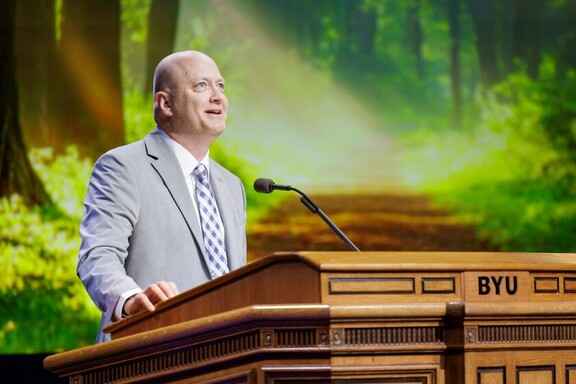
Scott Sommerfeldt, ASA Vice President

Scott Sommerfeldt’s exceptional career as a research scientist and professor has been complemented by his outstanding service to both Brigham Young University (BYU) and his professional societies.

From 2003-2007, Scott served as chair of the BYU Physics and Astronomy Department and as Dean of the College of Physical and Mathematical Sciences from 2007-2017.  His leadership as Dean allowed for significant advances in mentored student research funded by generous donations to the College.

Concurrent with this University service, Scott has contributed significantly to professional societies.  He served twice on the board of directors of the Institute of Noise Control Engineering of the United States of America from 2002-2005 and then from 2009-2012.  As Fellow of the Acoustical Society of America (ASA), he was a member of the ASA Technical Council from 2000-03 (for Structural Acoustics) and 2012-2015 (representing the area of Noise) and on the ASA Executive Council 2009-2012.  

Scott was elected Vice President of the ASA in 2017. He served one year as the Vice President Elect (2017-2018), one year as the Vice President (2018-2019), and is just finishing his year as Past Vice President (2019-2020).  Each of these titles is associated with different responsibilities that ensure continuity for the volunteer-led ASA.  

Scott’s clear thinking, steady approach, and diplomatic leadership has significantly benefited both BYU and the societies that form his professional home.

News and Events

BYU's new Biological Physics course introduces students to the physics behind biological processes, fostering interdisciplinary skills to tackle complex biological questions.
Dr. Kent Gee has been named the recipient of the Karl G. Maeser Distinguished Faculty Lecturer Award
The BYU Physics & Astronomy department recently introduced the Applied Physics: Acoustics degree.
After 3 years of being offered as 513R, elementary particle physics is finally an official course and accepted for credit in the physics major!
BYU Physics and Astronomy Professors Dr. Davis and Dr. Vanfleet recently received the 2024 award for outstanding achievement in technology transfer from the BYU Technology Transfer Office.
Dr. Michael Ware hopes to help students develop the skills to navigate discussion of science and religion
The university's new electron microscopy facility opened in fall of 2025, offering atomic-level imaging and student-led research.
Brian Anderson and his students celebrated BYU's 150th birthday by blowing out candles using high-intensity focused sound waves.
This year’s Karl G. Maeser Distinguished Faculty Lecturer, Kent Gee, delivered his forum address on the science of sound and how he and BYU students have contributed to significant research in the acoustics industry.
In July 2025, Drs. Branton Campbell and Harold Stokes (BYU Emeritus Professor) will receive the Kenneth N. Trueblood Award from the American Crystallographic Association for exceptional achievement in computational crystallography.
A group of undergraduate students braved the heat and heights of the ESC roof to install a new weather station. The station is up and running, and will hopefully record data for years to come.
Using data from NASA's Hubble Space Telescope, a new study suggests that an object previously thought to be a binary system may be a rare triple system of orbiting bodies.
Dr. Gus Hart received the 2024 Karl G. Maeser Research and Creative Arts Award for his work in computational material science and his continued innovation in computational methods.
This winter, ten students in BYU’s new “Advanced Planetary Astrophysics” taught by Darin Ragozzine course gained hands-on experience in planetary science research, mastering interdisciplinary skills to prepare for future careers in astronomy.
Starting Fall 2025, BYU will offer a new Applied Physics: Data Science major that combines rigorous physics training with data science skills to prepare students for the growing demand in data-driven careers.