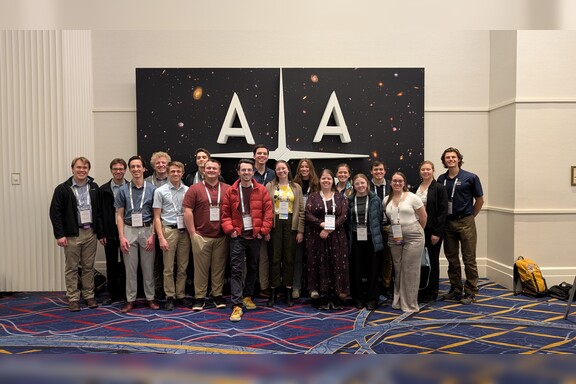
The Conference for Undergraduate Women in Physics (CUWiP) is an event designed to help young women network and build empowering relationships across universities. The conference, hosted by the American Physical Society (APS), was held in fourteen separate locations that invited hundreds of undergraduate students to learn together and celebrate their accomplishments. BYU’s Physics and Astronomy Department sent twenty-one students and two faculty members to the conference at Montana State University in Bozeman, Montana, which was the largest number of attendees from a single organization. Throughout the three-day conference, students listened to keynote speakers, presented their research, and attended panels that focused on work-life balance, preparing for graduate studies, and diversity in the workplace.
Anyone familiar with advanced STEM classes knows that very few women take these classes compared to men. This presents a unique challenge to young women, that being they can often feel alone, which causes discouragement and isolation. The CUWiP conference helps students make connections with others like them. Dr. Traci Neilsen of BYU’s Department of Physics and Astronomy explained, “the conference helped our students to feel like they do belong in physics and see themselves as Physicists and Astronomers.” Dr. Denise Stephens, also from the department and a panelist at the event, said, "it's empowering to know that you're not alone… I think that the power of CUWiP is seeing all these women in all these career positions."
Presenting and networking are large parts of academic research, but can be hard to learn without direct experience. CUWiP provides an incredibly supportive environment for undergraduate students to present. Four students from BYU presented posters and three gave talks. During the talks, the audiences were engaged and excited to ask questions, and the poster session attendees were enthusiastic and genuine. Public speaking can be nerve-wracking, but CUWiP has made itself a wonderful place to practice. Maia, an undergrad from BYU who gave a research talk, said that “the presentation sessions at CUWiP made me feel as part of the scientific community in a very big way, helping me feel like I was in the right place and around other people like me.”
Conferences such as this are vital in overcoming the gender discrepancy in STEM fields because they provide a space where women feel like they belong. Perri, one of the students who presented a poster, said she was able to “overcom[e] the anxiety of networking because it was such a supportive and uplifting environment.” The APS also announced the creation of the Gender Inclusive Physics Community and invited all CUWiP attendees to become inaugural members. Efforts such as these are vital in overcoming a history of gender discrimination within the sciences. Abi Mae, another student who gave a research talk, said that as we “get to know [our] fellow women in physics… we can all support each other even as we are at different schools.” By providing an opportunity for undergraduates to go to CUWiP, BYU has played a role in helping women in physics to thrive.
Authors:
Kaelyn Clement
Maia Anna Nelsen
Timothy David Morrell
Tanner D. Rydalch
News and Events