Kent Gee Forum: Lessons from Noise, Crackle to Calm

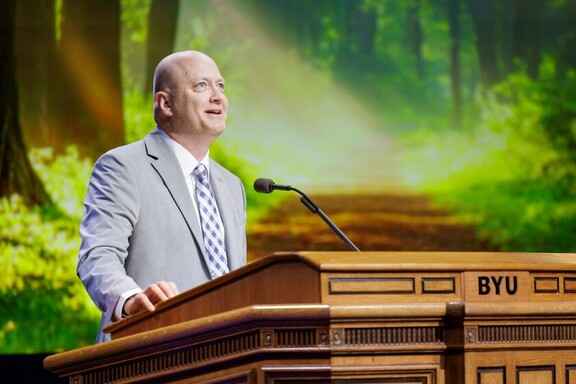
Kent Gee in Marriot Center
Kent Gee delivering the university forum. Photo by Ashlee Jarvis/BYU Photo

By Bitsy Tullis, June 03, 2025

This year’s Karl G. Maeser Distinguished Faculty Lecturer, Kent Gee, delivered his forum address on the science of sound and how he and BYU students have contributed to significant research in the acoustics industry.

Gee is a professor of physics and chair of the Department of Physics and Astronomy which has led to in-depth research surrounding noise. In his address, he referenced how many of his students have written papers that have been published in top journals. Their research has recently earned national media attention and even garnered them nicknames like the “sonic detectives” from the New York Times.

Their latest work with NASA’s X-59 aircraft aims to make supersonic travel quieter — with “sonic thumps" replacing sonic booms.

“This revolutionary aircraft will soon be flown supersonically over communities to determine acceptability of a thump-thump sound predicted to be like distant thunder,” Gee explained.

Last fall, Gee’s acoustic team also measured the thunderous noise of the world’s most powerful rocket, exploring its impact on communities and the environment.
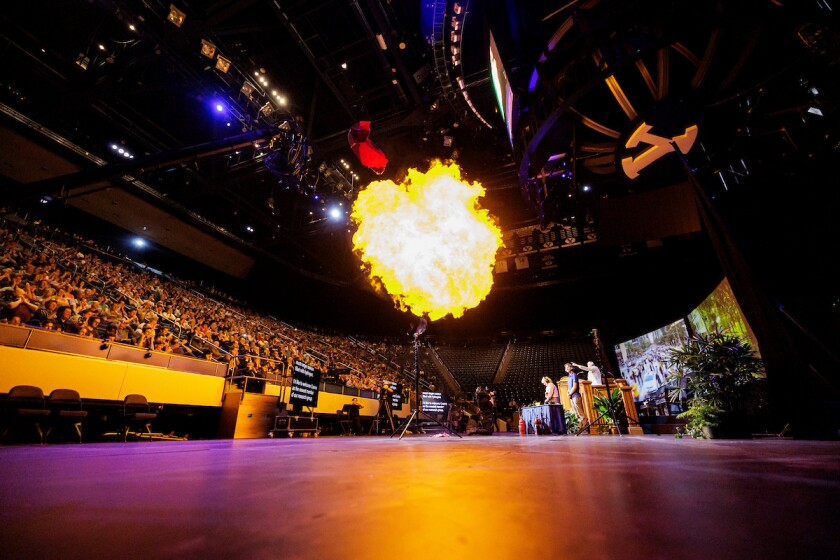
Exploding balloon
The forum included practical demonstrations of sound, such as exploding balloons. Photo by Ashlee Jarvis/BYU Photo

Throughout their research, they’ve shown that noise research isn’t just about decibels, but it’s about impact, intentionality and finding calm in a noisy world.

“I am confident that there are meaningful steps we each can take to tune out the crackle and find the calm… all for the benefit of the world," Gee said.

He demonstrated different hearing thresholds and decibels with explosive experiments illustrating sound-wave behavior. He highlighted how noise, whether environmental or emotional, can be harmful.

Gee encouraged listeners to view inner disruptions, such as imposter syndrome or self-doubt, as opportunities to more clearly tune in to what truly matters, especially when striving to follow Jesus Christ. He emphasized the spiritual necessity of finding quiet moments to hear God’s voice.

“I hope you’ll continue to make connections as to the impacts of all kinds of noise in our lives.'He that hath ears to hear, let him hear,'” Gee concluded.

More Information on This Article

Article Source/Further Information

News and Events

The university's new electron microscopy facility opened in fall of 2025, offering atomic-level imaging and student-led research.
Brian Anderson and his students celebrated BYU's 150th birthday by blowing out candles using high-intensity focused sound waves.
This year’s Karl G. Maeser Distinguished Faculty Lecturer, Kent Gee, delivered his forum address on the science of sound and how he and BYU students have contributed to significant research in the acoustics industry.
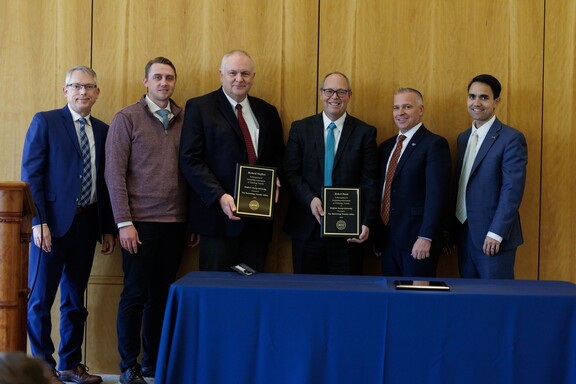
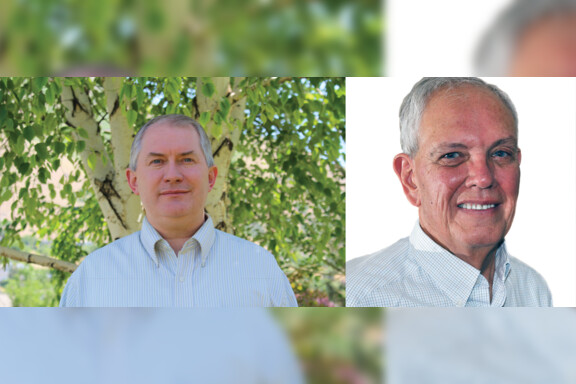
In July 2025, Drs. Branton Campbell and Harold Stokes (BYU Emeritus Professor) will receive the Kenneth N. Trueblood Award from the American Crystallographic Association for exceptional achievement in computational crystallography.
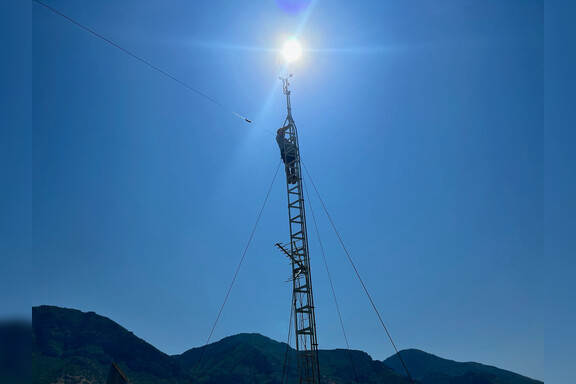
A group of undergraduate students braved the heat and heights of the ESC roof to install a new weather station. The station is up and running, and will hopefully record data for years to come.
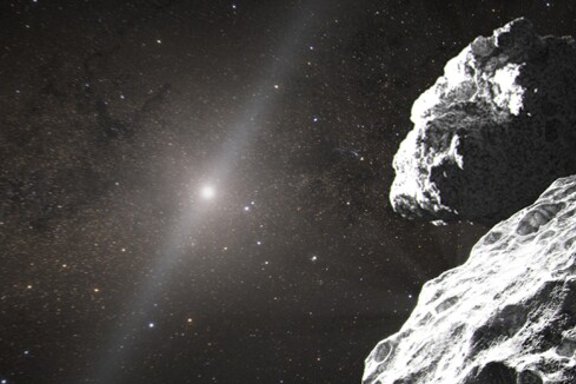
Using data from NASA's Hubble Space Telescope, a new study suggests that an object previously thought to be a binary system may be a rare triple system of orbiting bodies.
Dr. Gus Hart received the 2024 Karl G. Maeser Research and Creative Arts Award for his work in computational material science and his continued innovation in computational methods.
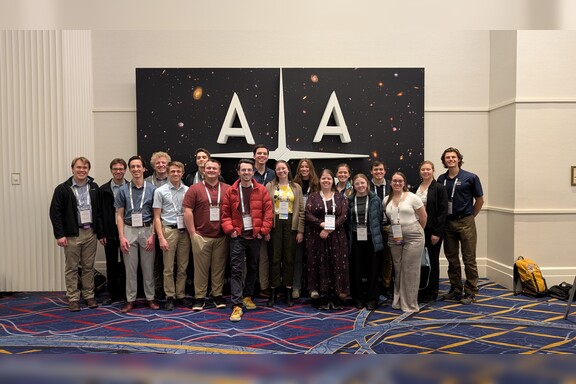
This winter, ten students in BYU’s new “Advanced Planetary Astrophysics” taught by Darin Ragozzine course gained hands-on experience in planetary science research, mastering interdisciplinary skills to prepare for future careers in astronomy.
Starting Fall 2025, BYU will offer a new Applied Physics: Data Science major that combines rigorous physics training with data science skills to prepare students for the growing demand in data-driven careers.
BYU's new Biological Physics course introduces students to the physics behind biological processes, fostering interdisciplinary skills to tackle complex biological questions.
Dr. Kent Gee has been named the recipient of the Karl G. Maeser Distinguished Faculty Lecturer Award
The BYU Physics & Astronomy department recently introduced the Applied Physics: Acoustics degree.
After 3 years of being offered as 513R, elementary particle physics is finally an official course and accepted for credit in the physics major!
BYU Physics and Astronomy Professors Dr. Davis and Dr. Vanfleet recently received the 2024 award for outstanding achievement in technology transfer from the BYU Technology Transfer Office.
Dr. Michael Ware hopes to help students develop the skills to navigate discussion of science and religion