Drs. Davis and Vanfleet Receive Technology Transfer Award

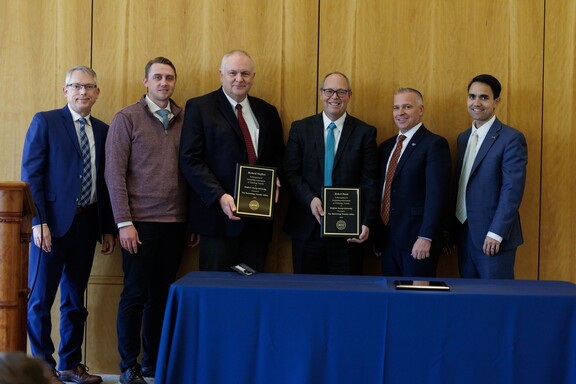
From left to right: Larry Howell (Associate Academic Vice President), Bennett Mortensen (Technology Transfer Office), Richard Vanfleet, Robert Davis, Shane Reese, Justin Collings (Academic Vice President)

BYU Physics and Astronomy professors Dr. Davis and Dr. Vanfleet recently received the 2024 award for outstanding achievement in technology transfer from the BYU Technology Transfer Office. This award recognizes their efforts in transferring intellectual property from the university to industry, leading to practical applications. Their work on material physics, including leveraging carbon fibers and carbon nanotubes, has allowed them to develop technology that has led to advances in x-ray detection, chemical analysis, and health analysis and monitoring.

Over the years, Dr. Davis and Dr. Vanfleet have successfully transferred intellectual property including patents and know how to external companies that often fund the BYU research. The creation and transfer of these technologies have been a long-term effort, spanning more than 20 years and resulting in over 30 issued patents. Along the way, they have mentored 81 undergraduates and 22 graduate students in research.  

One of their recent developments involved miniaturizing a short-wavelength infrared spectrometer resulting in a 3 mm × 4 mm × 14 mm sensor. They used a carbon nanotube composite collimator in the spectrometer, which has resulted in an increase in resolution in diffuse light applications like wearable optical monitoring. The collimator selects for light perpendicular to the spectrometer sensor, blocking off-axis light and resulting in higher spectral resolution.  This spectrometer technology was licensed to Live Tula for wearable health monitoring. 

For 20 years, Drs. Davis and Vanfleet have endeavored to connect the education and industrial worlds by introducing businesses and organizations to new technologies while connecting students with industrial research and potential employers. 

Electron microscope image of a collimator
Scanning Electron Micrograph of Carbon Nanotube Collimator

Student Authors: Authors: Nathan Van Dyke, Carter Colton, Nicholas LeVar

Edited by Faculty of BYU's Dept. of Physics and Astronomy

News and Events

Please remember to submit abstracts for the 2026 student research conference. Abstracts are due January 31 at midnight.
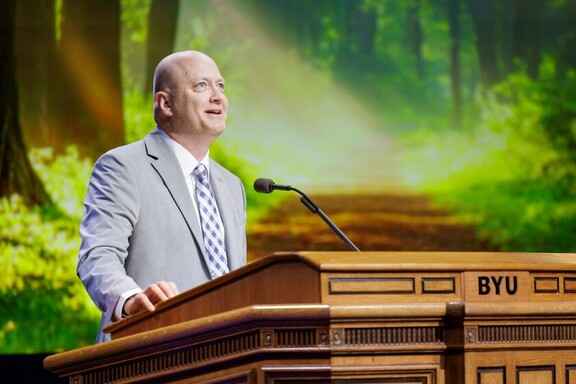
This year’s Karl G. Maeser Distinguished Faculty Lecturer, Kent Gee, delivered his forum address on the science of sound and how he and BYU students have contributed to significant research in the acoustics industry.
In July 2025, Drs. Branton Campbell and Harold Stokes (BYU Emeritus Professor) will receive the Kenneth N. Trueblood Award from the American Crystallographic Association for exceptional achievement in computational crystallography.
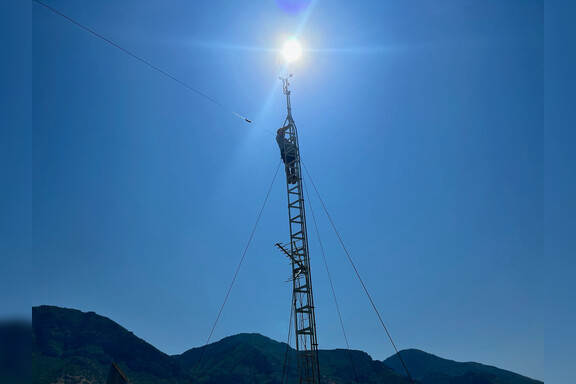
A group of undergraduate students braved the heat and heights of the ESC roof to install a new weather station. The station is up and running, and will hopefully record data for years to come.
Using data from NASA's Hubble Space Telescope, a new study suggests that an object previously thought to be a binary system may be a rare triple system of orbiting bodies.
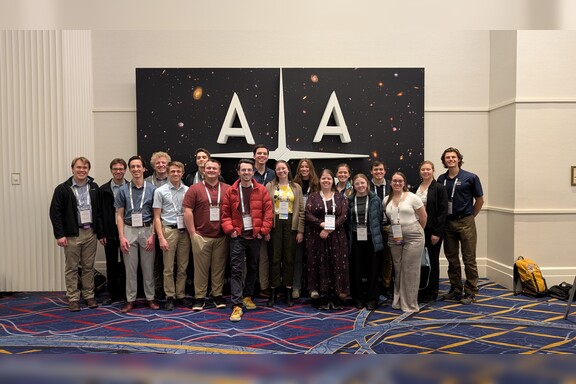
In early January 2025, a group of 16 students from Brigham Young University’s Physics & Astronomy Department showcased their research at the prestigious American Astronomical Society (AAS) in National Harbor, Maryland.
Dr. Gus Hart received the 2024 Karl G. Maeser Research and Creative Arts Award for his work in computational material science and his continued innovation in computational methods.
This winter, ten students in BYU’s new “Advanced Planetary Astrophysics” taught by Darin Ragozzine course gained hands-on experience in planetary science research, mastering interdisciplinary skills to prepare for future careers in astronomy.
Starting Fall 2025, BYU will offer a new Applied Physics: Data Science major that combines rigorous physics training with data science skills to prepare students for the growing demand in data-driven careers.
BYU's new Biological Physics course introduces students to the physics behind biological processes, fostering interdisciplinary skills to tackle complex biological questions.
Dr. Kent Gee has been named the recipient of the Karl G. Maeser Distinguished Faculty Lecturer Award
The BYU Physics & Astronomy department recently introduced the Applied Physics: Acoustics degree.
After 3 years of being offered as 513R, elementary particle physics is finally an official course and accepted for credit in the physics major!
BYU Physics and Astronomy Professors Dr. Davis and Dr. Vanfleet recently received the 2024 award for outstanding achievement in technology transfer from the BYU Technology Transfer Office.
Dr. Michael Ware hopes to help students develop the skills to navigate discussion of science and religion