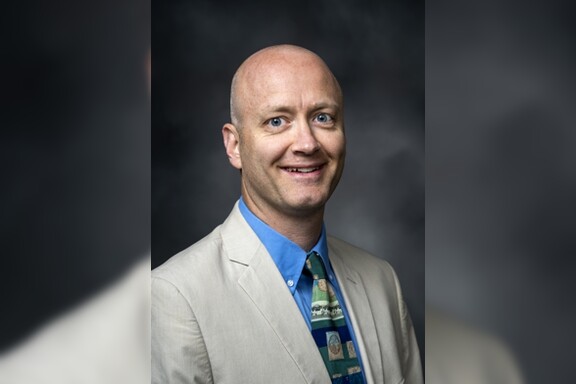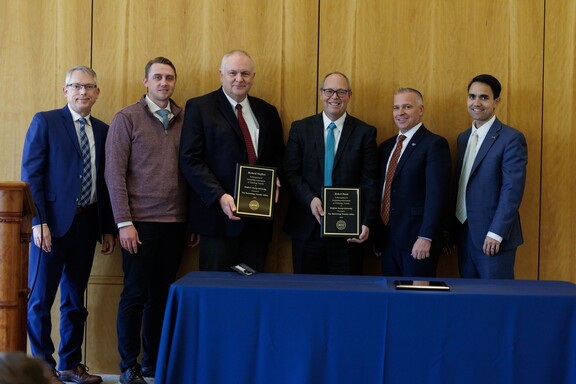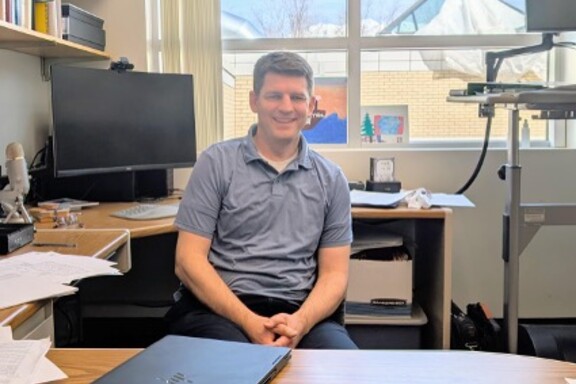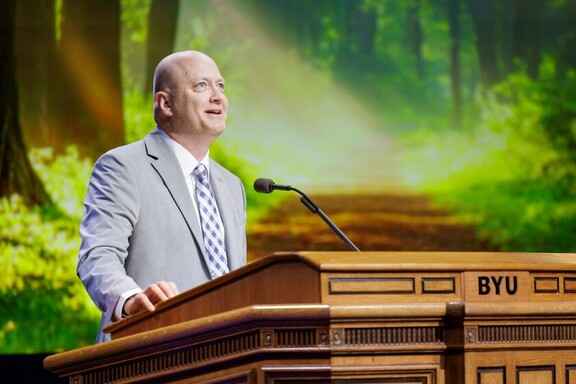
 Branton Campbell (left) and Harold Stokes (right)
In July 2025, Drs. Branton Campbell and Harold Stokes (BYU Emeritus Professor) will receive the Kenneth N. Trueblood Award from the American Crystallographic Association for exceptional achievement in computational crystallography. This award is given every 3 years to recognize scientists who have significantly influenced the structural science community through their development of computer programs that enable transformative new ways of studying the structure of materials and molecules on atomic length scales. The structural science community consists of many different scientists, including solid-state physicists/chemists, materials scientists, protein crystallographers, and more. The award manifests the huge impact of Campbells’ and Stokes' research program on the structural science community.
Campbell was trained as an experimentalist but switched to purely computational studies after his collaborative success in developing new computational tools for characterizing crystal phase transitions, which are now part of the ISOTROPY Software Suite of computational crystallography tools. Due to the powerful utility of these tools, other scientists frequently ask for his help in modeling materials, which led him to focus on computational work for most of his career.
Campbell speaks highly about his many years of experience working with Stokes. They began their work together when Stokes was Campbell’s undergraduate advisor, and they later worked together closely as collaborators. Campbell commented that Stokes is “just the best collaborator…if you give him an interesting problem, he tackles it quickly and sends it right back to you.” He also describes Stokes as being able to do very careful work. These two friends and research partners still have an ongoing collaboration even though Stokes retired in 2012, later serving a mission for The Church of Jesus Christ of Latter-day Saints in Scotland.
This partnership has led to some incredible science. What began as a potential solution to a specific crystallographic modeling problem has blossomed into the field that Campbell and Stokes pioneer today. Together they develop methods—using group representation theory—that offer an effective way of organizing the various ways to break symmetry in crystalline materials. These symmetries lead to many of their observable properties. Externally altering the material's structure (e.g. by lowering the temperature) can break symmetries and change its properties drastically. Predicting the effects of symmetry breaking is an arduous and extensive task; it requires in-depth knowledge of the material’s intrinsic structure and the local electronic environment. The ISOTROPY computational suite has tools that relate the possible ways for symmetries to break and predicts the associated structural changes. The image pictured below depicts an example crystal structure (a cooperative pattern of polyhedral rotations) in tetragonal tungsten-bronze modeled using ISODISTORT and ISOTILT (within the ISOTROPY suite).

The work done by Campbell and Stokes has left a lasting impact on the crystallography community that continues to influence modern research. Their pioneering work has not only advanced the abilities of crystallographic analysis but also continues to inspire a new generation of scientists. The Kenneth N. Trueblood Award stands as a fitting recognition of their partnership and groundbreaking contributions to science.
Student Authors: Trigg Randall, Amelia Poulin, Levi Hancock, and Abi Mae Carpenter
Edited by Brian Anderson
News and Events