New ESC Weather Station

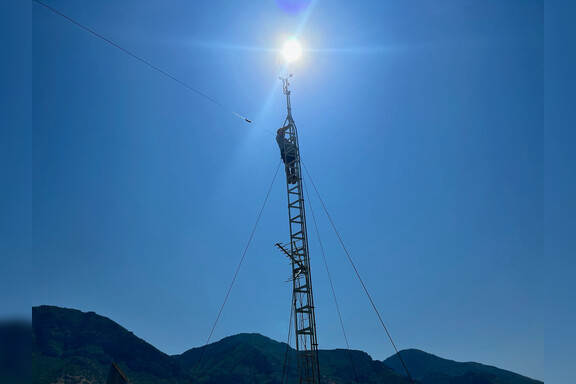
ESC Weather station with Y-Mountain in background
The new weather station (left) atop the Eyring Science Center

For decades, the BYU Physics and Astronomy Department has hosted a weather station on the roof of the ESC. Bryan Peterson was the station’s mastermind, carefully interpreting input data from a variety of sensors, conditioning analog and digital signals to record temperature, humidity, pressure, cloud cover, rainfall, and wind speed and direction. In fact, Bryan’s weather station detected a seismoacoustic wave generated by a volcano in Tonga in 2022, an atmospheric disturbance that started half a world away (https://doi.org/10.1126/science.abo7063).

Last year, the department upgraded the station. The new station has all the sensors integrated into a single unit, and it reports all the data digitally, through a convenient web interface. Students Matthew Schlitters and Ben Farley helped faculty members Michael Ware and Scott Bergeson replace the hardware. They climbed onto the ESC roof, scaled the weather station tower (with proper double-safety climbing gear), retired the old sensors, and installed the new station. Current and recent weather is available on the department web page and at https://physics.byu.edu/department/weather. Archival data is still available, and can be accessed through the same site.


News and Events

A group of undergraduate students braved the heat and heights of the ESC roof to install a new weather station. The station is up and running, and will hopefully record data for years to come.
Nobel Laureate Kip Thorne Inspires BYU Students with the Future of Gravitational-Wave Science
Four Decades Under the Stars: Honoring Dr. Mike Joner and the Legacy of West Mountain Observatory.
Connecting Experience to Opportunity: External Advisory Council Supports Career Pathways and Job Success for BYU Physics and Astronomy Students.
From Trapped Ions to Quantum Frontiers: Dr. AJ Rasmusson Launches Experimental Quantum Physics at BYU.
Dr. Gus Hart received the 2024 Karl G. Maeser Research and Creative Arts Award for his work in computational material science and his continued innovation in computational methods.
This winter, ten students in BYU’s new “Advanced Planetary Astrophysics” taught by Darin Ragozzine course gained hands-on experience in planetary science research, mastering interdisciplinary skills to prepare for future careers in astronomy.
Starting Fall 2025, BYU will offer a new Applied Physics: Data Science major that combines rigorous physics training with data science skills to prepare students for the growing demand in data-driven careers.
BYU's new Biological Physics course introduces students to the physics behind biological processes, fostering interdisciplinary skills to tackle complex biological questions.
Dr. Kent Gee has been named the recipient of the Karl G. Maeser Distinguished Faculty Lecturer Award
The BYU Physics & Astronomy department recently introduced the Applied Physics: Acoustics degree.
After 3 years of being offered as 513R, elementary particle physics is finally an official course and accepted for credit in the physics major!
BYU Physics and Astronomy Professors Dr. Davis and Dr. Vanfleet recently received the 2024 award for outstanding achievement in technology transfer from the BYU Technology Transfer Office.
Dr. Michael Ware hopes to help students develop the skills to navigate discussion of science and religion
The university's new electron microscopy facility opened in fall of 2025, offering atomic-level imaging and student-led research.