Time Reversal For BYU's 150th Birthday

BYU Birthday Cake

By Abigail Degn, October 28, 2025


BYU is marking its 150th anniversary with a creative spin on a classic celebration: blowing out birthday candles in BYU style.

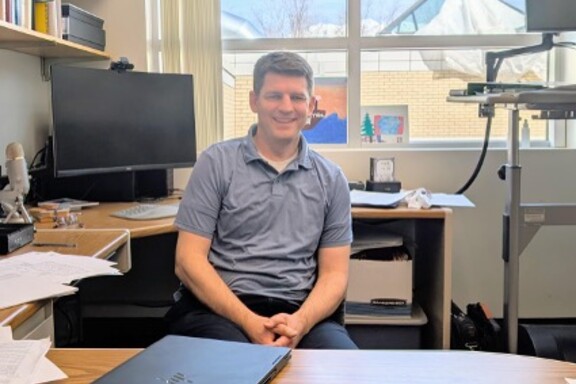
Instead of a traditional breath to extinguish the flames, BYU turned to science. Physics and Astronomy professor Brian Anderson helped “blow out” the 150 candles on a BYU-themed cake with remotely placed loudspeakers using a process he studies and teaches at BYU: time reversal acoustics. Others have blown out candles with sound, but this technique can be used to blow out candles anywhere in the room, even far away from the loudspeakers.

Students lighting candles on cake
BYU Physics and Astronomy professor Brian Anderson (second from left) works with students to align loudspeakers in a reverberation chamber as part of a time reversal acoustics experiment used to “blow out” 150 candles on a BYU-themed cake, celebrating the university’s 150th anniversary. (Photo by BYU Video)

This technique works by first recording how sound travels from a distant source, like a loudspeaker, to a receiver, like a microphone. Then, playing the recorded sounds backward with the last sound played first, and the first sound played last, creates focused sound waves back at the microphone location where they originally were recorded. This experiment is done in a reverberation chamber where sounds bounce around the room in an intentionally complex manner, but amazingly time reversal can create a coherent, focused wave among the chaos, like a reversed circular ripple in a pond from a thrown rock.

“To blow out each candle, we generated 180 decibels of sound at each candle location. For reference, a rock concert is about 120 decibels. So, this is about a thousand times louder than a rock concert at each of those candle locations,” Anderson shared.

Time reversal acoustics has many practical uses, such as destroying a kidney stone without invasive surgery; however, for this birthday celebration, the technique is used for fun.

This demonstration works because of the heat rising from the candles, which creates a small channel of warm air, and that helps jets of air to form in the focused sound to blow the candles out. Recently, Anderson and one of his students published a paper on the physics behind this process. Although it looks simple, Anderson says it’s surprisingly complex.

With the festivities continuing throughout this sesquicentennial year, Anderson says he’s grateful to be a part of it. He hopes this demonstration is a small way to show appreciation for the university.

“The 150th birthday of BYU allows all of us to think about the heritage that we have all benefited from, from all the people that have contributed over the years” Anderson says, “I like to think of this demonstration as providing a metaphor for how Christ can focus on and minister to each of us one by one, even in a noisy and chaotic world.”

More Information on This Article

Article Source/Further Information

News and Events

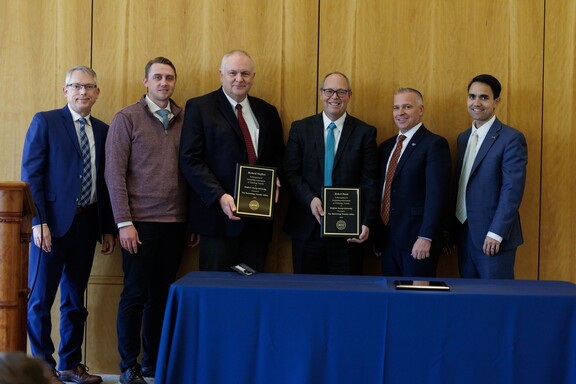
BYU Physics and Astronomy Professors Dr. Davis and Dr. Vanfleet recently received the 2024 award for outstanding achievement in technology transfer from the BYU Technology Transfer Office.
Dr. Michael Ware hopes to help students develop the skills to navigate discussion of science and religion
The university's new electron microscopy facility opened in fall of 2025, offering atomic-level imaging and student-led research.
Brian Anderson and his students celebrated BYU's 150th birthday by blowing out candles using high-intensity focused sound waves.
This year’s Karl G. Maeser Distinguished Faculty Lecturer, Kent Gee, delivered his forum address on the science of sound and how he and BYU students have contributed to significant research in the acoustics industry.
In July 2025, Drs. Branton Campbell and Harold Stokes (BYU Emeritus Professor) will receive the Kenneth N. Trueblood Award from the American Crystallographic Association for exceptional achievement in computational crystallography.
A group of undergraduate students braved the heat and heights of the ESC roof to install a new weather station. The station is up and running, and will hopefully record data for years to come.
Four Decades Under the Stars: Honoring Dr. Mike Joner and the Legacy of West Mountain Observatory.
Connecting Experience to Opportunity: External Advisory Council Supports Career Pathways and Job Success for BYU Physics and Astronomy Students.
From Trapped Ions to Quantum Frontiers: Dr. AJ Rasmusson Launches Experimental Quantum Physics at BYU.
Dr. Gus Hart received the 2024 Karl G. Maeser Research and Creative Arts Award for his work in computational material science and his continued innovation in computational methods.
This winter, ten students in BYU’s new “Advanced Planetary Astrophysics” taught by Darin Ragozzine course gained hands-on experience in planetary science research, mastering interdisciplinary skills to prepare for future careers in astronomy.
Starting Fall 2025, BYU will offer a new Applied Physics: Data Science major that combines rigorous physics training with data science skills to prepare students for the growing demand in data-driven careers.
BYU's new Biological Physics course introduces students to the physics behind biological processes, fostering interdisciplinary skills to tackle complex biological questions.
Dr. Kent Gee has been named the recipient of the Karl G. Maeser Distinguished Faculty Lecturer Award