The acoustics research program at BYU is cross-disciplinary, involving the treatment of both fundamental and applied problems in acoustics and vibration using analytical, numerical, and experimental means. Our faculty and students actively work on a wide range of projects related to acoustic signal processing, machine learning, aeroacoustics, noise control, architectural acoustics, audio acoustics, nonlinear acoustics, outdoor sound propagation, sound focusing, underwater acoustics, musical acoustics and structural acoustics. Many resources are readily available for the effective simulation, measurement, and understanding of physical systems. In addition to strong computational facilities, the program has acoustical laboratories with extensive state-of-the-art measurement equipment, two anechoic chambers, two reverberation chambers, and a variable acoustics chamber that can be used for experimental studies.
See the Acoustics Research Group Website for further information.
Group Meetings
| Title | Time | Day | Room |
|---|---|---|---|
| Acoustics Group Meeting | 3 pm | Th | N127 |
| Neilsen Hydroacoustics Research Meeting | 3 pm | F | N288 |
Acoustics Faculty Members
Brian Anderson
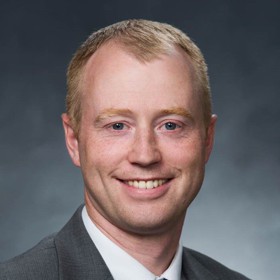
Research Specialty: Sound focusing, vibration focusing, nondestructive testing, communications, ultrasonics, electro-acoustic transduction, transducer arrays, elastic and fluid media
Contact
- Office: N377 ESC
- bea@byu.edu
- acoustics.byu.edu
Research Projects
-
Time reversal acoustics to found vibration in plates and structures
Suitable for
- Undergraduate students
- Graduate students
-
Time reversal acoustics to found sound in a water tank
Suitable for
- Undergraduate students
- Graduate students
-
Advanced investigations of acoustics education demonstrations
Suitable for
- Undergraduate students
- Graduate students
-
Time reversal acoustics to found sound in reverberation chambers
Suitable for
- Undergraduate students
- Graduate students
Kent Gee
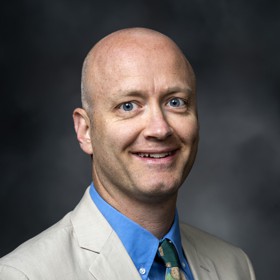
Research Specialty: Nonlinear acoustics, physical acoustics, jet aeroacoustics, acoustics education
Contact
- Office: N281A ESC
- 801.422.1544
- kentgee@byu.edu
- acoustics.byu.edu
Research Projects
-
Research in shock waves and high-amplitude acoustics
A lot of my research involves high-amplitude noise, like jets, rockets, explosions, and sonic booms. Other possibilities exist - email me to set up an appointment. Numerous publication opportunities are likely.
I'm *always* looking for new students in this area. Right now I'm looking for 2-3 students.
Suggested Preparation:We'll teach you!
Suitable for- Undergraduate students
- Graduate students
- REU students
-
Environmental Noise Monitoring and Modeling
I am working with Dr. Transtrum and graduate students on a project to use machine learning and geospatial features (nighttime radiance, precipitation, forests, etc.) to predict ambient soundscapes throughout the U.S., and eventually, globally. We have a need for 1-2 outdoor-oriented students interested in conducting making sound measurements in different urban and rural environments, formatting the data outputs, analyzing them, and helping to feed them into the machine learning models created by the graduate students.
Suggested Preparation:Experience with Excel useful. Likely requires some hiking from time to time.
Programming experience in Matlab or Python a plus.
Interest in learning about acoustics and instrumentation.
Suitable for- Undergraduate students
- Graduate students
- REU students
-
Machine learning and crowd noise
This project, with Dr. Transtrum, combines machine learning with crowd noise at sporting events. We want to detect cheering, booing, or even the beginning of crowd violence. This could involve taking data, analyzing them for features that relate to crowd engagement or sentiment, or developing new machine learning models.
We are currently looking for two students, one on the acoustics side for measurement and analysis, and one on the machine learning side.
Suitable for- Undergraduate students
- Graduate students
- REU students
-
Passive acoustical monitoring of wildlife
Passive acoustic monitoring of wildlife has many purposes, but include studying population health, size, and dynamics. We're currently doing research at the Bear River Migratory Bird Refuge, looking at how water and other environmental factors impact bird choruses. We may also be starting to do rocket noise-related research - as launches can affect noise sensitive species - in California.
I'm looking for a student interested in measurements and analysis.
Suggested Preparation:We'll teach you!
Suitable for- Undergraduate students
- Graduate students
- REU students
-
Military jet noise
We study the noise radiation from turbulent jet engine exhausts. We've studied the F-22, the F-35, and the T-7A using lots of different methods for the Air Force and the Navy.
I'm looking for 1-2 students to join this group of ~5 students.
Suggested Preparation:We'll teach you!
Suitable for- Undergraduate students
- Graduate students
- REU students
Traci Neilsen
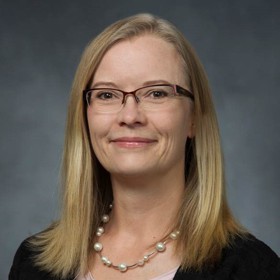
Research Specialty: Underwater acoustics, Acoustic source localization, Inverse methods, Machine learning applications in underwater acoustics
Contact
- Office: N269 ESC
- 801.422.7056
- traci.neilsen@byu.edu
- hydroacoustics.byu.edu/
Research Projects
-
Computational Underwater Acoustics
Sound propagation in the ocean depends on the properties of the water column, seafloor, and acoustic source. Our research uses physics-based acoustic models, sensitivity analysis, information geometry, optimization, and machine learning to determine what environmental properties can be inferred from recorded sound. Current projects use ship-noise spectrograms and other acoustic data in deep learning algorithms to estimate seabed properties, characterize sediment heterogeneity, improve source ranging and localization, ocean sound classification, and quantify uncertainty in these inferences.
Students gain experience in numerical modeling, scientific computing, signal processing, inverse problems, optimization, and deep learning—valuable preparation for careers in industry, national laboratories, and graduate study.
Suggested Preparation:Desire to learn about acoustics and dive into numerical modeling and/or machine learning.
Computer coding experience is helpful. This project uses Python.
Suitable for- Undergraduate students
- Graduate students
- REU students
-
Underwater Acoustical Measurements
Our underwater acoustics laboratory in U117 includes a fully automated, 12-foot-long by 4-foot-wide water tank for making controlled ultrasonic acoustic measurements. We use these measurements to test and refine numerical models of sound propagation, study the effects of temperature-driven sound-speed variability, and evaluate source-ranging, localization, transfer-learning, and other machine-learning methods.
Students work with acoustic sources and hydrophones, robotic positioning systems, measurement protocols, signal processing, and experimental data analysis. This experience provides excellent preparation for graduate study in acoustics, ultrasound, medical physics, and related fields, as well as for technical careers requiring experimental and computational skills.
Suggested Preparation:Desire to learn
Attention to detail
Suitable for- Undergraduate students
- Graduate students
- REU students
Micah Shepherd
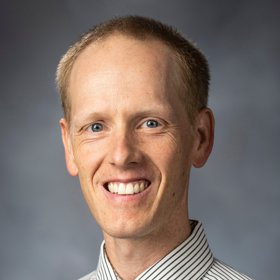
Research Specialty: Structural Acoustics, Musical Acoustics, Analysis of Wave or Wave-like Data
Contact
- Office: N488 ESC
- 801.422.1498
- shep@physics.byu.edu
Research Projects
-
Vibration-based Sound Power
1) Expand the vibration-based sound power method to unbaffled plates
2) Measure the vibration of plates with different geometries using laser vibrometry
Suitable for- Undergraduate students
- Graduate students
- REU students
-
Physics of Musical Instruments
1) Perform high resolution measurements of the directivity of musical instruments, especially percussion and string instruments
2) Develop physical models of the vibration and sound radiation of string instruments
3) Investigate of nonlinear behavior in cymbals
Suitable for- Undergraduate students
- Graduate students
- REU students
-
Signal Characterization of Seizures
1) Study the mechanisms of seizure propagation and termination in mice models through the development of advanced analysis and visualization techniques
2) Characterize the onset of moderate and severe seizure events using machine learning
This research is performed in collaboration with Dr. Ryley Parrish from BYU's College of Life Science.
Suitable for- Undergraduate students
- Graduate students
- REU students
-
Launch Vehicle Acoustics
1) The use of acoustic intensity in the near- and far-field of a rocket to localize the acoustic source as a function of frequency.
2) The use of model-scale rockets to better understand the acoustic behavior of full-scale rockets.
Suitable for- Undergraduate students
- Graduate students
- REU students
-
Thermoelasticity
1) Measure thermoelastic damping in plates and beams of various metals with differing thickness profiles
2) Investigate the temperature dependence of thermoelastic damping in metal beams
3) Explore the relationship between thermoelastic damping and material grain structure
Suitable for- Undergraduate students
- Graduate students
- REU students