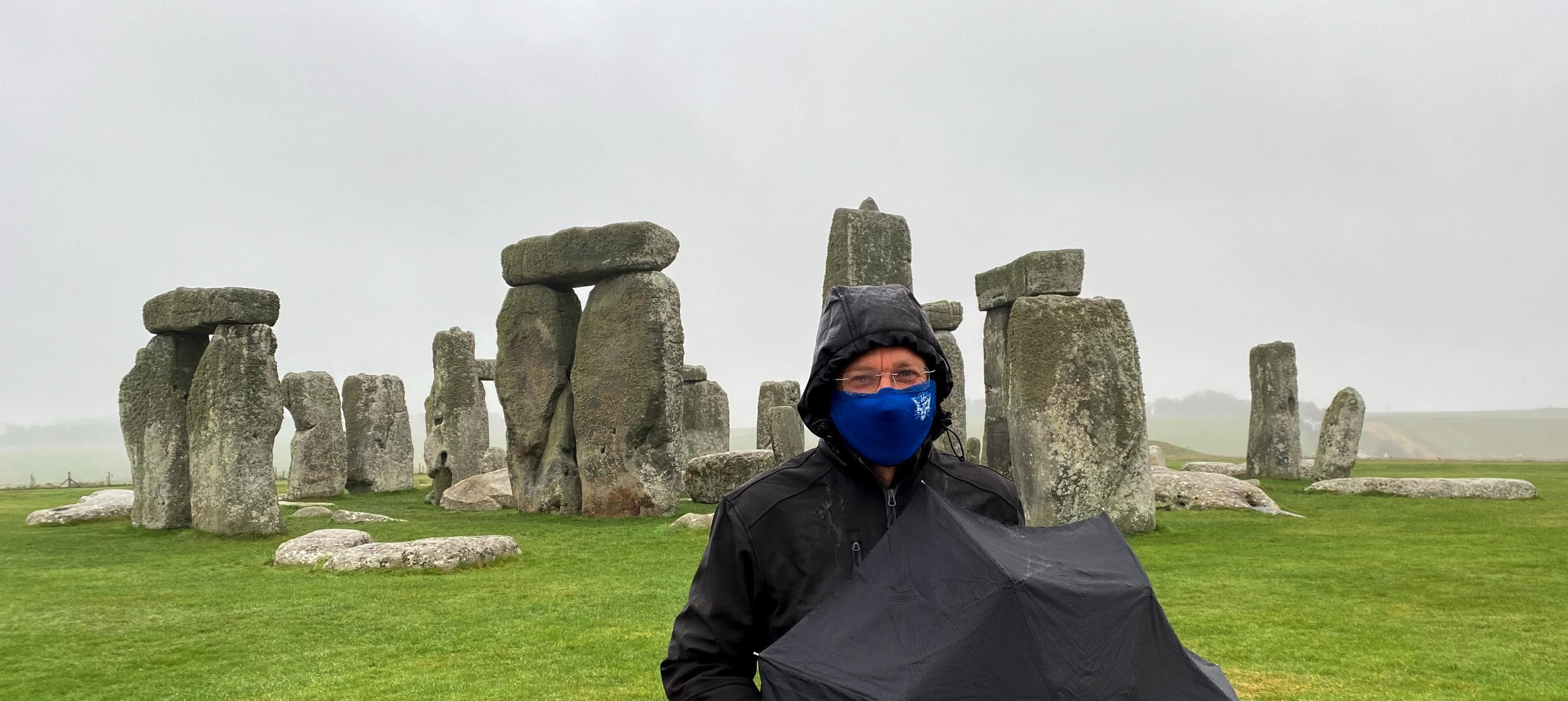
Dr. Gus Hart had a six month sabbatical at the University of Cambridge, working with his collaborator Dr. Gabor Csanyi. They are designing new techniques for constructing interatomic potentials--think of an interatomic potential as a model of how atoms interact with each other which doesn’t require all the complexity of quantum mechanics. Atomic interaction models based on quantum mechanics exist, but they are slow and computationally expensive. Interatomic potentials, on the other hand, are much faster and cheaper to run, but still accurately represent the atomic behaviors. These models have applications in material science research, allowing scientists to study new materials on the computer instead of in the lab, which saves both time and money. Dr. Hart is leveraging many ideas from machine learning in his research, a synthesis which he describes as “really exciting.”
Dr. Hart’s sabbatical experience did not go untouched by the COVID-19 pandemic. He and his family lived in the Cambridge area, but sightseeing and travel outside the region was largely discouraged. He was only allowed on campus only two days a week. He met with his collaborator and other researchers at Cambridge face-to-face, but only in one-on-one meetings held outside. He was not been able to visit other scientists in the UK or Europe, as he had planned. He has only attended his local Church meetings virtually. Despite it not being the cultural experience he was hoping for, Dr. Hart still described his experience thus far as “amazing.” He and his family have enjoyed getting to know their neighbors and making a few good friends, and the atmosphere at Cambridge is exciting and “tremendous academically.”
This is the first time Dr. Hart has been able to take a sabbatical. When asked his thoughts on the experience so far, Dr. Hart shared, “I have learned so much. It has helped me in mentoring my students and helped me develop new skills and given me a broader perspective. I'm a better scientist. I am so excited about my field and the others it connects to. I wish more faculty would make the necessary effort to take a sabbatical. It isn't easy to relocate for 6-12 months, to move your kids to new schools or a new country, to make trade-offs, but for me it has been rewarding, well worth the sacrifice. I can't wait to do it again---hopefully without a pandemic.”
(Student contributors: Benjamin Szamosfalvi, Jason Saunders, and Nathan Chanhyun Pak)


