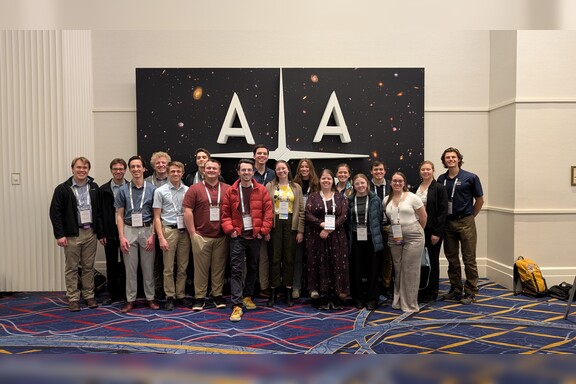
This past January, undergraduate women from Brigham Young University attended the Conference for Undergraduate Women * in Physics (CU*IP). CU*IP is hosted by the American Physical Society (APS) at various locations across the nation. APS describes CU*IP as a resource for students, providing opportunities to “find mentors, explore education and career opportunities, and network with and learn from fellow students who are women * and underrepresented identities in physics.” At the conference, students have the opportunity to present research through oral presentations or poster sessions, as well as participate in Q&A panels and career fairs.
About 20 BYU students attended CU*IP this year. These 20 students were assigned to two locations—one group attended the conference at the University of California, Berkeley, and the other at California Polytechnic State University.
The group of students that attended UC Berkeley consisted of mostly freshmen and a couple of juniors. A freshman in the BYU Physics and Astronomy department, Olivia Pincock, expressed that “everyone has different backgrounds and experiences, but we can all learn something from each other.” Oliva explained that attending the conference with other freshmen from BYU helped her to form lasting friendships and study groups in her classes. Chantelle Gimenez, a junior majoring in Physics Education, mentioned that the CU*IP conference opened her mind to the variety of career options with a degree in physics. The conference also reinforced the importance of community for Chantelle. She discussed how easy it is to get caught in the cycle of homework and classes without creating connections with her peers. Chantelle felt that the conference was a worthwhile experience that provided her the opportunity to build relationships that will be beneficial now and in the future.
Natalie Bickmore and Madilyn Randall, seniors in the BYU Physics and Astronomy Department, reported on their participation in the CU*IP conference session held at Cal Poly in San Luis Obispo. Both students commented on how helpful the conference was in promoting understanding of the different career paths available to women in physics. Both expressed that research sometimes feels like the only job you can get with a physics degree; however, CU*IP allowed them to hear stories of those who found careers in industry or even as tutors. These experiences comforted Natalie and Madilyn regarding future career options. Women are still a minority in the physics realm and it can be daunting to envision a successful future. Madi said, “it was reassuring to talk to so many people who have the same doubts about their major and future career options. I’m not planning on doing research after I graduate, and the Q&A panels really helped me see that people can find cool jobs outside of research that they enjoy.” Hearing about others’ stories helped both Natalie and Madi to feel that they could find a place for themselves in physics.
Whether at UC Berkeley or CalPoly, CU*IP provided BYU students with confidence and reassurance in their academic pursuits. The conference also provided exposure to career paths that students were not aware of. Beyond academics, the conference fostered a sense of community, allowing students to connect with peers and professionals who share their experiences and challenges.
The next CU*IP conference in January 2026 is sure to inspire female undergraduate students and build a sense of belonging in the physics community. We have been able to send so many students due to generous alumni donations that support their travel costs. We thank those that have contributed and invite others to submit similar donations to the department, with the assurance that all donations support our students.
Student authors: Madilyn Randall, Natalie Bickmore, Dallin Harwood, Bryce Lundstrom
News and Events