Meet the External Advisory Council

Advisory council at the ESC

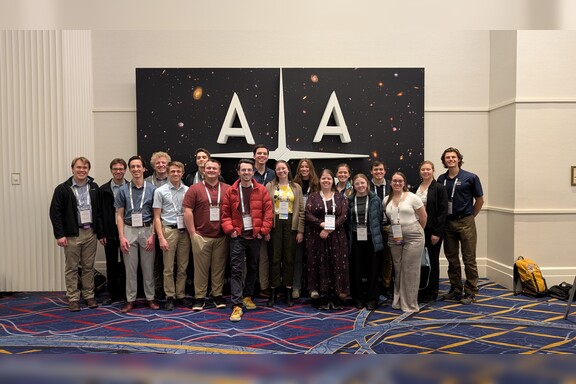
This fall, there’s a new resource to support physics students here at BYU: the External Advisory Council, or EAC. As a group of BYU alumni, the EAC member represent a variety of career paths, including acoustics, astronomy, aerospace, nuclear and medical physics, quantum computing, and teaching. Despite their diversity, this group has one important thing in common: their desire to help BYU students as we prepare to enter the job market. They have volunteered to lead alumni efforts to help BYU students develop marketable skills and they represent a great networking & mentoring resource. The EAC brings a unique perspective as industry professionals who know what it looks like to take physics and astronomy degrees into the workforce.

The mission of the External Advisory Council is threefold:

  • Support the mission of the department by identifying resources and opportunities for student research, possible internships, and other enrichments that would enhance student experience within the department.
  • Facilitate connections among students, faculty, and industry, and enable a more connected network of alumni.
  • Provide findings to the department leadership regarding current industry trends and practices to encourage a curriculum that remains relevant.

The EAC met for the first time in March 2025 and look forward to working with our amazing alumni to bless our incredible students!

I have personally seen how powerful a resource the EAC can be in my own life. After graduating, I want to pursue a career in medical physics—a field that is sometimes hard to find resources for at BYU. This past summer, however, I was able to shadow Nikki Maughan, a medical physicist on the EAC. It was an incredible experience for me to be able to see in person what medical physics looks like, and Nikki has become an amazing mentor to me. Her knowledge of the industry and graduate programs has really helped guide me as I’ve prepared to apply to graduate school, and she has helped me learn so much about the possibilities in medial physics. Through it all, I could feel that she really cares about me and that she wants me to succeed. This concern for students is characteristic of the members of EAC, and I look forward to seeing what happens as the help student connect with our alumni!

by Eben Lonsdale, Student Advisory Council

News and Events

Brian Anderson and his students celebrated BYU's 150th birthday by blowing out candles using high-intensity focused sound waves.
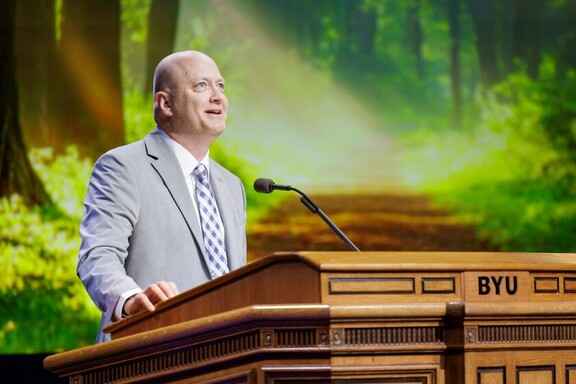
This year’s Karl G. Maeser Distinguished Faculty Lecturer, Kent Gee, delivered his forum address on the science of sound and how he and BYU students have contributed to significant research in the acoustics industry.
In July 2025, Drs. Branton Campbell and Harold Stokes (BYU Emeritus Professor) will receive the Kenneth N. Trueblood Award from the American Crystallographic Association for exceptional achievement in computational crystallography.
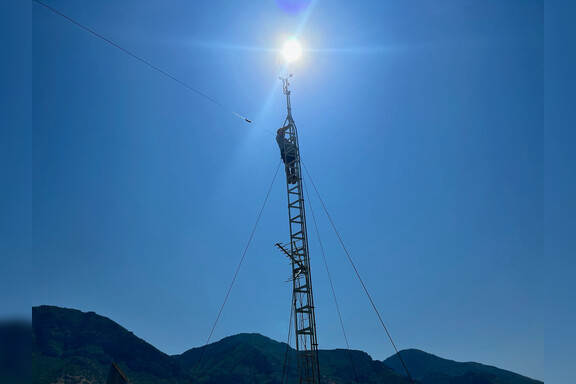
A group of undergraduate students braved the heat and heights of the ESC roof to install a new weather station. The station is up and running, and will hopefully record data for years to come.
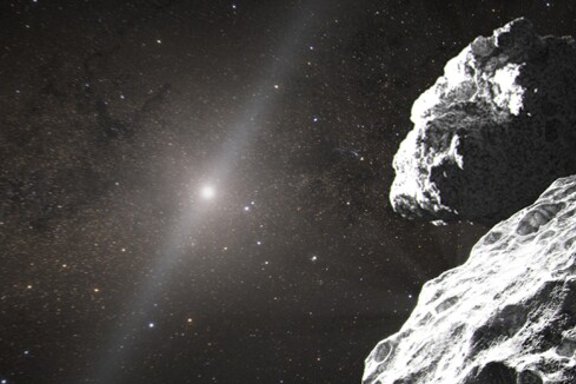
Using data from NASA's Hubble Space Telescope, a new study suggests that an object previously thought to be a binary system may be a rare triple system of orbiting bodies.
Dr. Gus Hart received the 2024 Karl G. Maeser Research and Creative Arts Award for his work in computational material science and his continued innovation in computational methods.
This winter, ten students in BYU’s new “Advanced Planetary Astrophysics” taught by Darin Ragozzine course gained hands-on experience in planetary science research, mastering interdisciplinary skills to prepare for future careers in astronomy.
Starting Fall 2025, BYU will offer a new Applied Physics: Data Science major that combines rigorous physics training with data science skills to prepare students for the growing demand in data-driven careers.
BYU's new Biological Physics course introduces students to the physics behind biological processes, fostering interdisciplinary skills to tackle complex biological questions.
Dr. Kent Gee has been named the recipient of the Karl G. Maeser Distinguished Faculty Lecturer Award
The BYU Physics & Astronomy department recently introduced the Applied Physics: Acoustics degree.
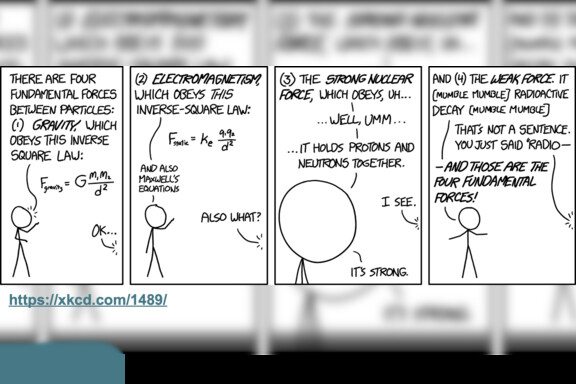
After 3 years of being offered as 513R, elementary particle physics is finally an official course and accepted for credit in the physics major!
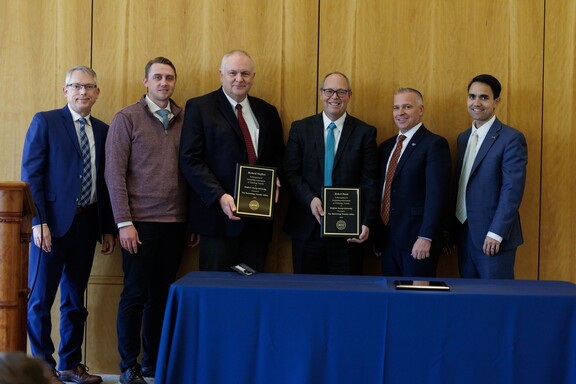
BYU Physics and Astronomy Professors Dr. Davis and Dr. Vanfleet recently received the 2024 award for outstanding achievement in technology transfer from the BYU Technology Transfer Office.
Dr. Michael Ware hopes to help students develop the skills to navigate discussion of science and religion
The university's new electron microscopy facility opened in fall of 2025, offering atomic-level imaging and student-led research.